The Rise of Agrivoltaics: How Farming Under Solar Panels Is Reshaping American Agriculture
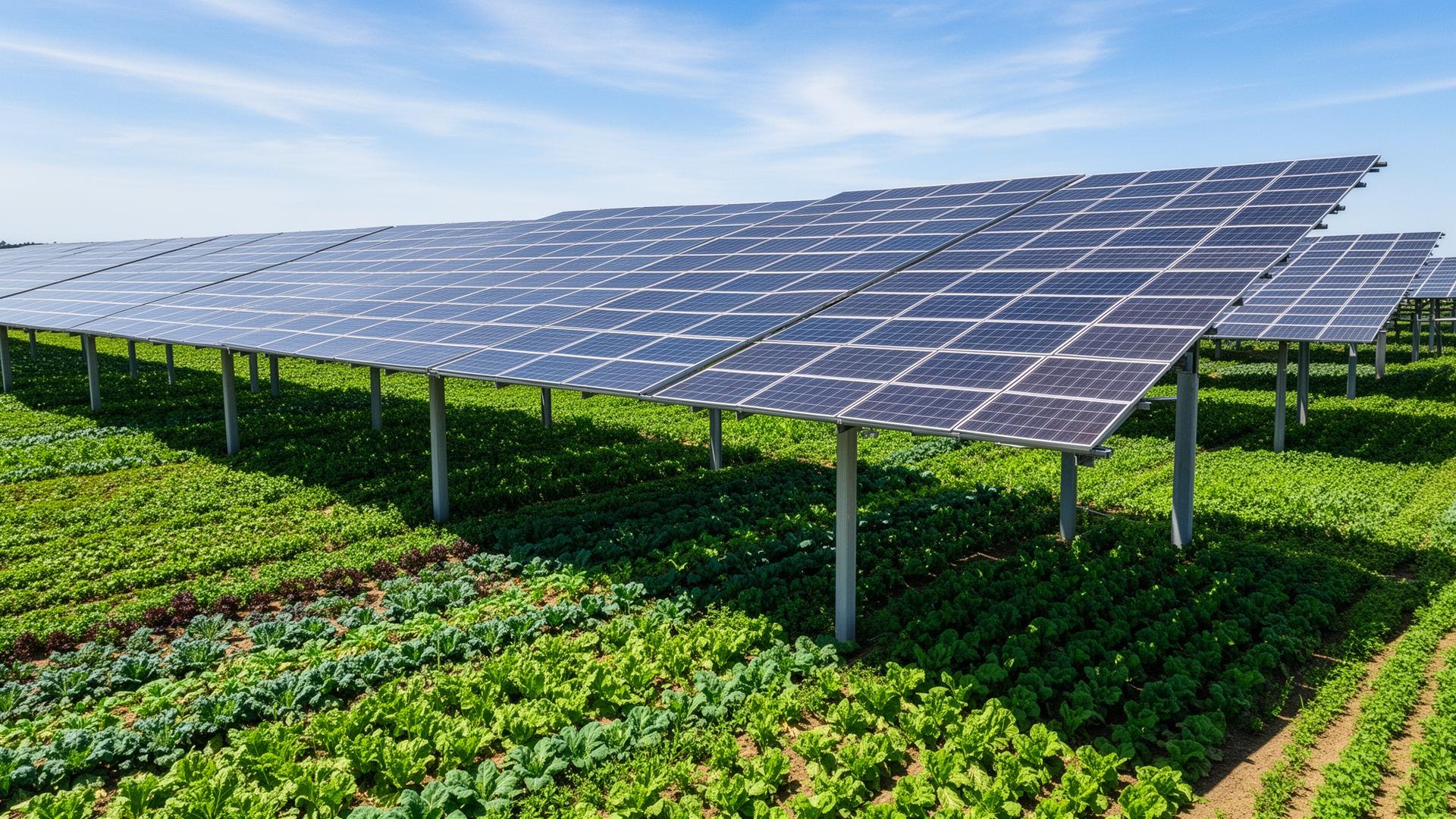
For decades, the expansion of utility-scale solar has faced a persistent critique: solar farms consume valuable agricultural land. In states like Ohio, Indiana, and Texas, local opposition to solar projects often centers on this very tension—the fear that productive farmland will be paved over with panels, never to grow crops again.
But a quiet revolution is reshaping this narrative. Agrivoltaics—the practice of co-locating solar panels and agricultural production on the same land—is moving from experimental curiosity to commercial reality. With more than 600 agrivoltaic projects now operating across the United States and a global market valued at $6.3 billion, the industry is proving that solar development and farming can coexist. In fact, they may thrive together.
What Is Agrivoltaics?
At its core, agrivoltaics is elegantly simple: install solar panels in a way that allows farming to continue underneath or between them. The concept dates back to 1981, when German physicist Adolf Goetzberger first proposed the idea. But commercial development didn't gain momentum until Japan pioneered elevated panel systems in the early 2010s.
Today, agrivoltaics takes two primary forms. The first is crop-based agrivoltaics, where panels are mounted high enough—typically 8 to 15 feet—to allow tractors and harvesting equipment to pass beneath. Farmers grow vegetables, herbs, berries, and specialty crops in the partial shade created by the panels. The second is solar grazing, where sheep, cattle, or other livestock graze on vegetation beneath and around conventional ground-mounted arrays.
The key insight driving agrivoltaics is land efficiency. A 2019 study published in Nature Sustainability found that co-locating solar and agriculture can increase overall land productivity by 60 to 70 percent compared to using the same land for either purpose alone. In an era of competing demands for land—food, energy, housing, conservation—that efficiency gain is transformative.
Success Stories Across America
The poster child for American agrivoltaics sits on five acres in Longmont, Colorado. Jack's Solar Garden, founded by Byron Kominek in 2019, has become the nation's largest research-focused agrivoltaic installation. Partnering with the National Renewable Energy Laboratory (NREL) and the University of Arizona, Kominek's farm has hosted dozens of research studies examining crop yields, pollinator habitat, and soil moisture retention under solar panels.
The results have been compelling. Researchers found that shade-tolerant crops like kale, chard, and peppers produced yields comparable to or exceeding those grown in full sun, while requiring 30 percent less irrigation water. The project has also demonstrated the economic viability of agrivoltaics for small and mid-sized farms seeking additional revenue streams.
Sol Systems, one of the nation's largest independent solar developers, declared 2025 its "breakthrough year" for agrivoltaics. The company has integrated agricultural co-use into multiple utility-scale projects, working with local farmers to maintain livestock grazing and specialty crop production alongside solar generation. Sol Systems reports that agrivoltaic design adds only 5 to 10 percent to project costs while dramatically improving community acceptance and permitting outcomes.
On the utility-scale frontier, the Coyote Creek Agrivoltaic Ranch in California represents the next generation of dual-use development. The 200-megawatt project combines solar generation with battery storage and active agricultural operations, creating what developers describe as a "working energy farm." The project employs local agricultural workers year-round and has secured long-term grazing agreements with regional ranchers.
Perhaps most significant is Enel North America's commitment to solar grazing. The company has deployed sheep grazing at dozens of its solar facilities across the country, managing vegetation naturally while supporting local agricultural economies. In 2024, Fast Company recognized Enel's program as a "World Changing Idea" in energy, highlighting how the approach transforms the relationship between solar developers and rural communities.
The Research Landscape
The scientific case for agrivoltaics has strengthened considerably over the past five years, driven by dedicated research programs at leading institutions.
NREL's InSPIRE (Innovative Site Preparation and Impact Reductions on the Environment) program, led by researcher Jordan Macknick, has emerged as the nation's premier agrivoltaics research hub. The InSPIRE team has developed what they call the "5 Cs of Agrivoltaic Success": Configuration (panel height, spacing, and orientation), Crop selection (matching plants to light conditions), Climate (regional growing conditions), Collaboration (developer-farmer partnerships), and Compensation (fair economic arrangements for all parties).
At the University of Arizona, Greg Barron-Gafford's lab has produced some of the most widely cited research on crop performance under panels. His team found that the microclimate created by solar panels—cooler temperatures during the day, warmer temperatures at night, and reduced evaporation—can actually benefit many crops, particularly in hot, arid regions. Chiltepin peppers grown under panels at the university's test site produced three times the fruit of those grown in full sun.
In Europe, Germany's Fraunhofer Institute for Solar Energy Systems (Fraunhofer ISE) has pioneered research on agrivoltaics since the early 2010s. The institute operates multiple test sites examining everything from wheat and potato production to vertical bifacial panel configurations that maximize both crop yields and energy generation.
The American Farmland Trust, a nonprofit focused on agricultural land preservation, released its comprehensive Solar Soil Health Guide in early 2025. The guide provides practical recommendations for developers and farmers seeking to maintain or improve soil health on solar sites, covering topics from cover cropping to pollinator habitat establishment.
Global Momentum
While the United States has emerged as a leader in agrivoltaic research, other countries have moved faster on deployment.
Japan pioneered commercial agrivoltaics with its "solar sharing" program, which has supported thousands of installations since 2013. Japanese regulations require that agrivoltaic sites maintain at least 80 percent of their pre-solar agricultural productivity—a strict standard that has driven innovation in panel design and farming techniques.
Germany and France have integrated agrivoltaics into their renewable energy targets, with the European Union providing dedicated funding for research and deployment. France's national agrivoltaics strategy, announced in 2023, aims to install 100 gigawatts of agrivoltaic capacity by 2050.
In Italy, agrivoltaics has found a natural home in the country's wine regions. Vintners report that the partial shade provided by panels can protect grapes from increasingly frequent heat waves, improving wine quality while generating clean energy.
Market analysts at Global Market Insights valued the worldwide agrivoltaics market at $6.3 billion in 2024 and project a 5.6 percent compound annual growth rate through 2034. The fastest growth is expected in Asia-Pacific, where land constraints and agricultural traditions favor dual-use approaches.
Policy Momentum in the States
American policymakers are taking notice. According to the National Caucus of Environmental Legislators, 12 agrivoltaic-related bills were introduced in 9 U.S. states during the 2025 legislative session—a threefold increase from 2023.
Nevada has emerged as a surprising leader, passing legislation that provides bonus incentives for solar projects that incorporate agricultural co-use. The state's approach recognizes that agrivoltaics can help address both renewable energy goals and water conservation challenges in the arid West.
Oklahoma, not typically associated with progressive energy policy, has seen bipartisan support for agrivoltaic development. Rural legislators have embraced the concept as a way to provide struggling farmers with supplemental income while maintaining the agricultural character of their districts.
At the federal level, the Inflation Reduction Act's domestic content bonuses and energy community credits can significantly improve the economics of agrivoltaic projects, though no dedicated agrivoltaics incentive currently exists. The USDA's Rural Energy for America Program (REAP) provides grants and loans that can support on-farm solar installations, including agrivoltaic configurations.
Challenges Ahead
For all its promise, agrivoltaics faces real obstacles to widespread adoption.
The most significant is cost. Elevated racking systems required for crop-based agrivoltaics add 15 to 30 percent to installation costs compared to conventional ground-mount systems. While these costs have declined with experience and scale, they remain a barrier for developers operating on thin margins.
Agronomic expertise presents another challenge. Successful agrivoltaics requires knowledge of both solar engineering and farming—a combination that few individuals or companies possess. Projects succeed when developers partner meaningfully with farmers, but such partnerships require time, trust, and fair compensation structures.
Panel configuration tradeoffs complicate system design. Higher panels allow more light to reach crops but reduce energy generation density. Wider row spacing accommodates farming equipment but increases land requirements. Every agrivoltaic project involves balancing these competing demands based on site-specific conditions.
Finally, insurance and liability questions remain unsettled. Who bears responsibility when livestock damages panels? How are crop losses during construction compensated? These issues require clear contractual frameworks that the industry is still developing.
The Path Forward
Despite these challenges, the trajectory of agrivoltaics points unmistakably upward. The technology is transitioning from pilot projects and research sites to productive economic activity at scale.
The next frontier may be hybrid agrivoltaic systems that integrate solar generation, battery storage, and agricultural operations into unified business models. Such projects could provide grid services, produce food, and generate multiple revenue streams from the same land—a compelling proposition for investors and communities alike.
Carbon credit markets offer another avenue for value creation. Agrivoltaic sites that implement regenerative grazing or carbon-sequestering cover crops could potentially stack energy revenue, agricultural income, and carbon payments—a "triple bottom line" that no single land use could achieve alone.
From my perspective, having followed the solar industry for over a decade, agrivoltaics represents something rare: a genuine innovation that addresses legitimate criticisms of renewable energy development. The land-use objection to solar has always carried moral weight. Agrivoltaics doesn't dismiss that concern—it answers it.
The question is no longer whether agrivoltaics works. The evidence is in. The question is how quickly the industry, policymakers, and farming communities can scale what works. If the current pace of innovation and policy support continues, agrivoltaics will become standard practice within a decade—not an exception, but an expectation.
The era of false choices between food and energy is ending. Under the panels, a new agricultural economy is taking root.